


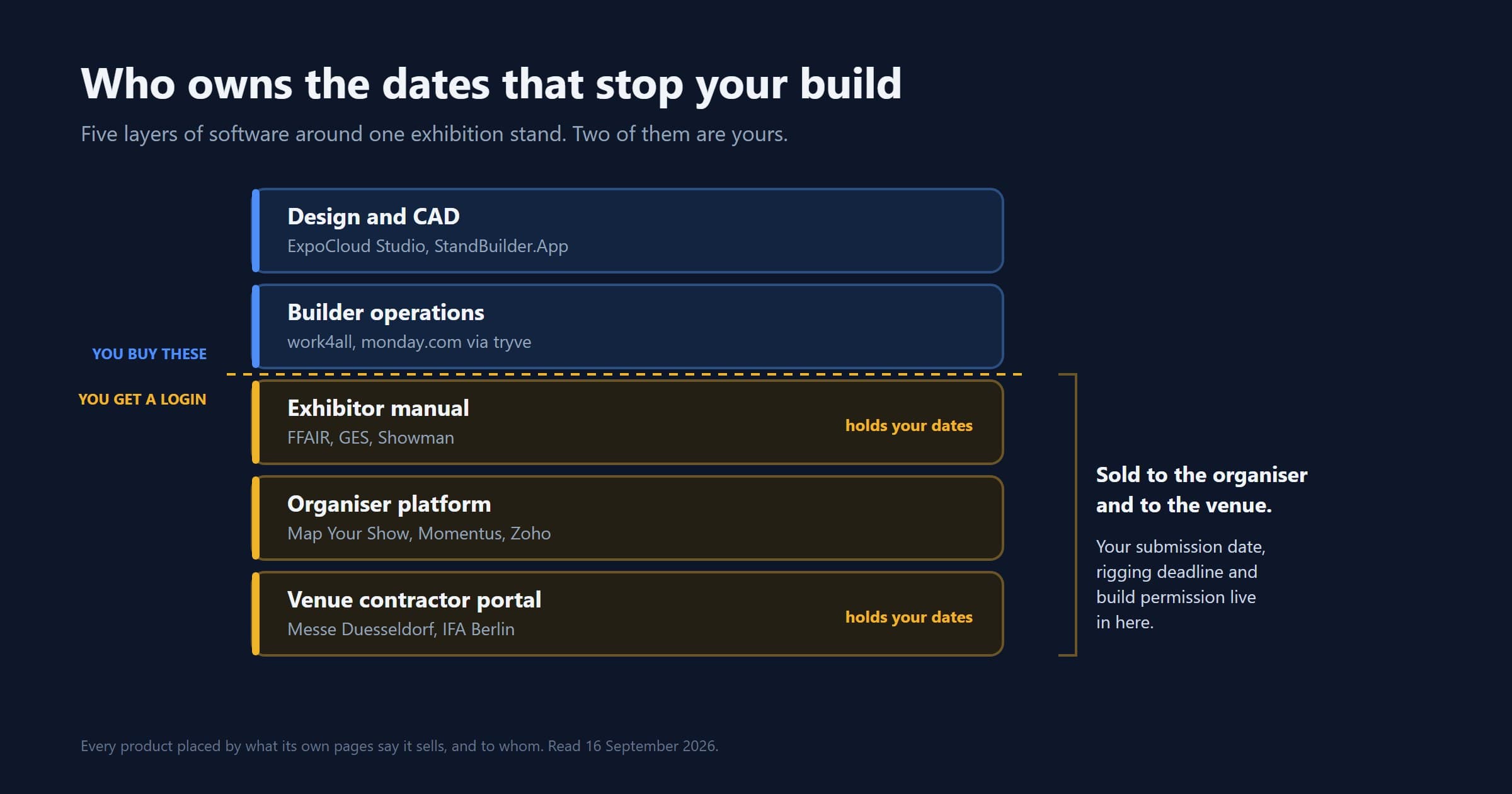
There is project management software for exhibition stand builders. It will not track the deadlines that stop your build. Those dates sit in two other systems. Both are sold to somebody else.
We went looking for a category leader. We found something more useful instead. The software around one stand build sits in five layers, and each layer has real products in it. However, the layer holding your submission date belongs to the organiser. The layer holding the technical guidelines belongs to the venue.
So "which tool should I buy" has a different answer than the search results suggest. Every product below is placed in the layer it occupies. Each one was read on the vendor's own pages on 16 September 2026.
What exists today, at a glance
- Design tools are not project tools. ExpoCloud Studio and StandBuilder.App output 3D stands, not schedules.
- Real builder-side software exists. work4all publishes a trade fair construction product with named modules.
- monday.com is being configured for this. One practice, tryve, publishes a stand builder setup dated 16 March 2026.
- The deadline engine is sold to organisers. FFAIR runs tasks, due dates and approvals. The buyer is the show.
- Venues run their own portals. Messe Düsseldorf operates a stand builder portal with the guidelines and fees in it.
- No builder-side product we read names a venue technical guideline.
Correcting our own topic note
Our keyword file said this category was vacant. That note was written on 8 September 2026. It is wrong, so here is the correction.
We re-ran the live results on 16 September. We found two products that do address running the project, and neither showed up in the first scan. The first is work4all, a German CRM and ERP with a page for trade fair construction. The second is tryve, which configures monday.com for stand builders. Publishing "nothing addresses running the project" would have been the exact error this cluster exists to correct. Notably, that is the kind of claim we go after in other people's articles. Therefore we are stating the correction in the open rather than dropping it quietly. The finding that survives is narrower, and it holds up better.
The five layers around one stand build
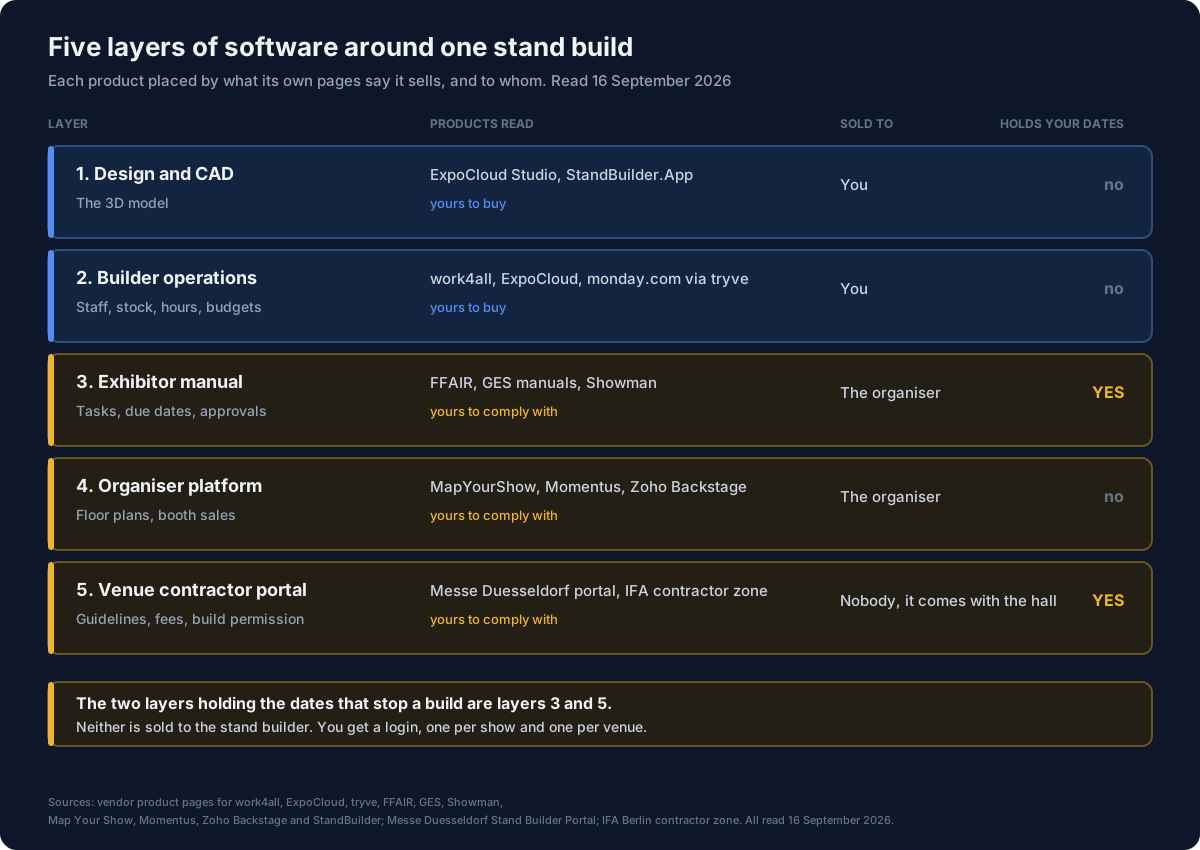
A layer is a system with its own owner, its own login, and its own idea of what a project is. The five do not talk to each other.
| Layer | Products read | Sold to | What it owns |
|---|---|---|---|
| 1. Design and CAD | ExpoCloud Studio, StandBuilder.App | Builders, exhibitors | The 3D model and the visual |
| 2. Builder operations | work4all, ExpoCloud, monday.com via tryve | Stand builders | Staff, stock, hours, subcontractors, budgets |
| 3. Exhibitor manual | FFAIR, GES manuals, Showman | Organisers | Tasks, due dates, approvals, order forms |
| 4. Organiser platform | MapYourShow, Momentus, Zoho Backstage | Organisers and venues | Floor plans, booth sales, exhibitor services |
| 5. Venue contractor portal | Messe Düsseldorf portal, IFA contractor zone | Nobody, it comes with the hall | Technical guidelines, fees, build permission |
Layers 1 and 2 are yours to buy. Layers 3, 4 and 5 are yours to comply with. That is the whole problem in one sentence. Consequently a stand builder ends up with a dozen logins for one show.
What the builder-side tools actually cover
They manage your company, not your compliance. That describes layer 2 fairly, and it is not a criticism. It is what an ERP is for.
work4all names its modules directly. There is "Disposition of rental equipment", which answers the question its own page poses: "Will we still have enough Lem bar stools from 4 to 8 October during Anuga if we serve five customers at the same time?" There is "Resource planning using a plan calender", which asks who still has capacity. There is a barcode stock scanner for finding a part in the warehouse. There is a web shop for client ordering, and mobile time recording. The page says it coordinates "rental and storage materials, but also fitters, subcontractors and logistics". In other words, the project object is your own firm. Your people, your stock, your hours. That is genuinely useful, and it is not the same thing as your risk.
ExpoCloud publishes functional areas instead of modules. You "Define events, budgets and requirements in the portal". Then you "Select and manage stands, services and logistics directly", with a Europe-wide logistics flat rate on top. Notably it reads as a booking portal with project support attached.
tryve takes a third route. It is not a product at all. It is a practice that configures monday.com, and its page is dated 16 March 2026. It promises "clear project phases", "standard task sequences" and "responsibilities per role". It connects sales, production and delivery into one flow, "from the first client contact to final delivery". Thus what you get is a board shaped like your own process.
What none of them names
We searched each vendor's own feature pages for venue compliance. We found none of it. No technical guidelines. No drawing submission. No approval date.
That claim needs its limits stated, so here they are. We are not saying these tools cannot hold a deadline. Obviously a calendar holds any date you type in. We are saying something narrower, and checkable. On 16 September 2026, none of the builder-side product pages we read named a venue technical guideline, a drawing clearance, or a venue-set submission date in the features it advertises. The distinction matters, because the two kinds of date behave differently. A normal due date slips and the team reschedules. A venue date slips and, at Koelnmesse, a 20 percent surcharge lands on the rigging order. In short, the tools sell you the first thing. The second thing is what stops a build.
Why the deadline layer is not yours
Because the organiser bought it. The software that runs due dates and approvals is real and mature. It is aimed at the show, not at you.
An exhibitor manual is the organiser's online pack of everything an exhibitor needs before a show: checklists, order forms, safety guidance and venue rules. FFAIR sells one, and calls itself "A Smarter Way to Manage Exhibitors". Its Tasks module lets an organiser "Establish due dates and automatic alerts". It then lets them "Approve or reject Task submissions", with a full tracking history. It covers items it describes as ranging "from risk assessments to website profiles". Now read that from the builder's chair. You are not the user of this system. You are the thing it tracks. That inversion is the finding, and it repeats across the layer.
GES files its version under organiser services. It describes the goal as "Control revenue and timelines by keeping exhibitors on track with their orders". Showman, a third manual product, sells the ability to publish early "to provide exhibitors enough time to meet early deadlines". In fact every one of these is a machine for pushing dates at you. None of them is a place to keep yours.
The venue portal nobody counts as software
Messe Düsseldorf ships a stand builder portal, and tool round-ups never mention it. It is not sold. It comes with the hall.
The portal is addressed to stand builders and exhibitors. It carries set-up and dismantling times, traffic rules per fair, the Technical Guidelines, a 3D configurator, and Service Alliance ordering for rigging. It also holds the rule that decides whether you file drawings at all: "Provided that the Technical Guidelines are observed in the design and implementation of the stand, single-storey stand constructions in exhibition halls do further not require the submission of drawings for clearance."
Two numbers there matter to a 2027 quote. The inspection fee is EUR 105.00 for 2026 events. It rises to EUR 115.00 for events in 2027 and later. Our deadlines guide already publishes the EUR 105.00, read from the Technical Guidelines valid from 1 January 2026. The increase is new. We found it on the portal, not in the PDF, which is the pattern worth noticing. The current number reached the portal first.
IFA Berlin runs the same kind of zone for contractors. It publishes the sentence that ends any argument about what a deadline is: "You will not receive Permission to Commence Build until all required documents are submitted and approved." That is not a date. It is a gate.
The UK adds a duty no tool tracks
In Britain your plot is a construction project, and you are running it. That is not venue policy. It is regulation.
CDM 2015 is the Construction (Design and Management) Regulations, the UK rules that govern who is responsible on a construction site. The Health and Safety Executive applies them to exhibition work. Its guidance on roles and duties states that "It is also possible for separate construction projects to be carried out by different clients at the same venue, for example exhibitions and trade fares with 'space-only' plots." The typo is the HSE's own. Read the sentence for what it does: it makes each space-only plot a project in its own right, with its own client and its own contractor. Where several principal contractors work one hall at once, the guidance requires them to cooperate and coordinate, including over shared perimeters and traffic routes. Specifically, that is paperwork with your name on it. No product in layer 2 asked us about CDM.
The deadline stack one stand actually carries
One stand carries at least six independent dates, set by three parties, in documents that never reference each other. This table is the artifact this article adds. Every figure in it was read from a venue's own document for one of our earlier guides.
| Milestone | Where a venue publishes a date | Set by |
|---|---|---|
| Stand design submission | 6 weeks before set-up at Frankfurt, Cologne and Düsseldorf. 1 month before build-up at IFEMA | Venue |
| Two-storey authorisation | The same 6 weeks with more documents. 30 days before move-in in Las Vegas | Venue |
| Rigging plan | 8 weeks at Koelnmesse, with a 20 percent late surcharge. 4 weeks at RAI | Venue and its contractor |
| Electrical connection order | 4 weeks at Koelnmesse, conditional on circuit diagrams arriving with it. 28 days at RAI | Venue or named supplier |
The second half of the stack is where the trap sits.
| Milestone | Where a venue publishes a date | Set by |
|---|---|---|
| Rigging, Las Vegas | 21 days to Freeman and 14 days to LVCVA, in the same hall | Two parties, one hall |
| Electrical sign-off | Before energisation. Compulsory at Cologne, Düsseldorf, Amsterdam and Madrid | Venue or its expert |
| Payment deadline | Paid 15 days before the event at ADNEC, or the standard rate applies | Venue |
| Permission to commence build | No date at all. Gated on every document being approved | Organiser |
Las Vegas is the row to read twice. Two documents govern one hall and set different dates, which we covered in the rigging guide. A team working to the venue date alone is already a week late for the contractor. No software in layer 2 catches that. Neither date is in it.
Does monday.com or Asana work instead?
Yes, and that is most of the market. Generic work tools are what stand builders actually run on. tryve has a business because of it.
Here is the honest trade. A generic board is cheap. Your team already knows it, and it bends to your process. Conversely it knows nothing about your industry. Every venue rule you want it to enforce is a template you build and then maintain. For example, a Koelnmesse project needs its rigging task set 8 weeks out and its electrical order 4 weeks out. Somebody has to know that before the board can say it.
That is the real choice, and it is a choice between two kinds of work. Buy an industry ERP and get stock, staff and time handled, while compliance stays manual. Alternatively take a generic board and encode the compliance yourself. Either way the venue dates arrive by human hands. In fact that is exactly where the misses come from, and no vendor in this market currently claims otherwise.
What this means when you choose a system
Start from the layer you are missing, not from the shortlist. Most builders reading this already own layer 1 and something in layer 2.
Three tests before you sign anything:
- Ask where a venue deadline lives. Not a task due date. The date your design has to be at the venue. If the demo answers with a generic calendar, you are buying layer 2 and keeping the risk.
- Ask who owns the record when the show ends. Layer 3 access dies with the show. Anything you need next year must sit in a system you control.
- Count the logins per project. One portal per venue, one manual per organiser, plus your own tools. That number is the real cost, and no vendor quotes it.
Check any date here against the electrical requirements guide and the two-storey guide before you plan against it. Venue documents get revised, and shows issue their own versions.
FAQ: questions people actually ask
Is there project management software made for exhibition stand builders?
Yes. work4all publishes a trade fair construction product, with modules for rental equipment, resource planning, warehouse scanning and mobile time recording. ExpoCloud offers planning, booking, logistics and analytics in one portal. In addition, practices such as tryve configure monday.com for stand builders. What none of them advertises is venue compliance. On 16 September 2026, none of their published feature lists named a venue technical guideline or a stand drawing deadline.
Which software tracks venue approval deadlines?
The organiser's exhibitor manual does, and you cannot buy it. Products such as FFAIR give organisers tasks with due dates, automatic alerts, and the power to approve or reject submissions. Venues also publish their own contractor portals. The Messe Düsseldorf stand builder portal is one, and it carries the Technical Guidelines and the inspection fees. Both systems push dates at the builder. Neither is a place for a builder to keep a schedule across shows.
Do I need dedicated software, or is monday.com enough?
For most stand builders a generic board is enough, provided somebody owns the venue rules. Generic tools handle tasks, phases and budgets well, and they cost less. However they carry no knowledge of venue deadlines. A Koelnmesse rigging plan due 8 weeks out is only tracked if you build that template yourself. Dedicated products such as work4all add stock, staff and time control. Neither category removes the manual step of reading the venue's guidelines.
How we checked this
Our editorial rule is the one the rest of this cluster runs on. Every claim traces to a named, dated source, or it does not appear.
Each product above was read on its own published pages on 16 September 2026. The layer it sits in comes from what that vendor says it sells, and to whom. Every date in the stack was read from a venue's own document for an earlier article, and each of those documents is listed in that article's sources. We found no published figure for how often builders miss a venue deadline, so we give none. The printed late surcharges stand in its place.
One disclosure, because this article maps a category we work in. ExhibiPilot is building in layer 2, and the gap described above is the reason. We have tried to write the map we would want before choosing, rather than the one that flatters us. More about how we work is on our about page.
Spotted an error, or run a product we have put in the wrong layer? Tell us and we will correct it on the page, the way we corrected our own topic note above.
Sources
| # | Source | Publisher | Read | Supports |
|---|---|---|---|---|
| 1 | Trade fair construction and event | work4all | 2026-09-16 | The named modules, the multi-project claim, and the absence of any venue compliance feature |
| 2 | Cloud software for project management | ExpoCloud | 2026-09-16 | Planning, booking, logistics and analytics, and the logistics flat rate |
| 3 | Project management for exhibition stand builders | tryve | 2026-09-16 | The monday.com configuration, project phases and role responsibilities, page dated 16 March 2026 |
| 4 | FFAIR exhibitor management | FFAIR | 2026-09-16 | Tasks with due dates and alerts, approve or reject submissions, and the organiser as buyer |
| 5 | Exhibitor manuals | GES | 2026-09-16 | The manual filed under organiser services, and the revenue and timelines framing |
| 6 | Online exhibitor manual | Showman | 2026-09-16 | Early publication so exhibitors can meet early deadlines |
| 7 | Map Your Show | Map Your Show | 2026-09-16 | Floor Builder and the Exhibitor Resource Center, and the organiser audience |
| 8 | Exhibition management software | Momentus | 2026-09-16 | Booth sales, exhibitor services, floor plans, tasks and invoices for venues and organisers |
| 9 | Stand Builder Portal | Messe Düsseldorf | 2026-09-16 | The drawing clearance rule, and the EUR 105.00 fee rising to EUR 115.00 from 2027 |
| 10 | Contractor zone deadlines | IFA Management GmbH | 2026-09-16 | Permission to Commence Build, and the 8 week battery approval lead time for IFA 2026 |
| 11 | CDM roles and duties in entertainment | Health and Safety Executive | 2026-09-16 | Space-only plots as separate construction projects, and coordination between principal contractors |
| 12 | StandBuilder 3D | AetherEx | 2026-09-16 | Its own title, "3D Exhibition Stand Builder", which is what places it in the design layer. The page returns no further copy to a fetch |
| 13 | Zoho Backstage | Zoho | 2026-09-16 | Organiser-side event management and floor plan booth booking |
On currency. Vendor pages change without notice, and none of the products above publishes a version history. Therefore treat every capability claim here as read on 16 September 2026, including the absences.