

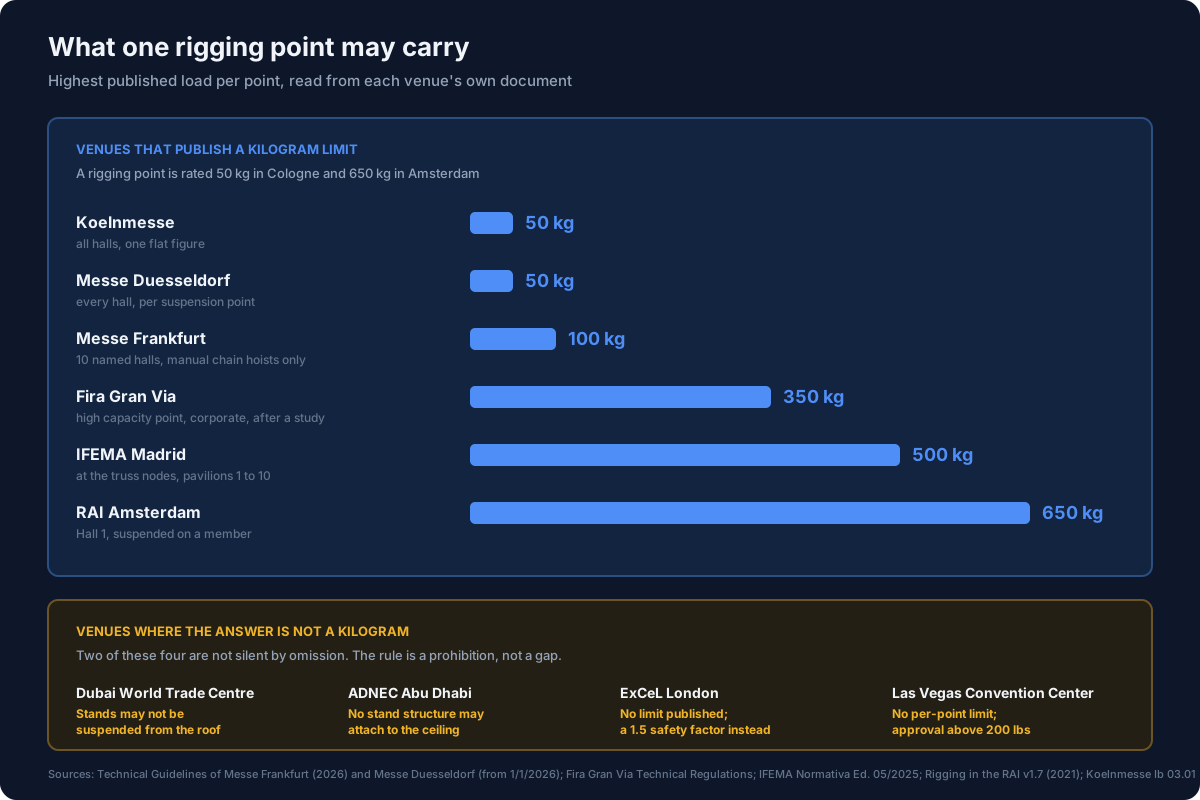
There is no industry rate for exhibition stand rigging, and no industry load limit either. A rigging point is rated 50 kg in Cologne and 650 kg in Amsterdam. That is a thirteenfold spread, and it is published in documents anyone can download.
Search for what rigging costs and you get a range. Between GBP 400 and GBP 900. Between GBP 800 and GBP 2,500. Notably, no venue is attached to either figure. No document. No date.
Those ranges repeat across six of the ten results on page one. However, not one cites a source. Meanwhile ExCeL London publishes a full 2026 rate card openly, and no ranking page mentions it. As on the deadlines article, every figure below is read from a venue's own document.
What the venues publish, at a glance
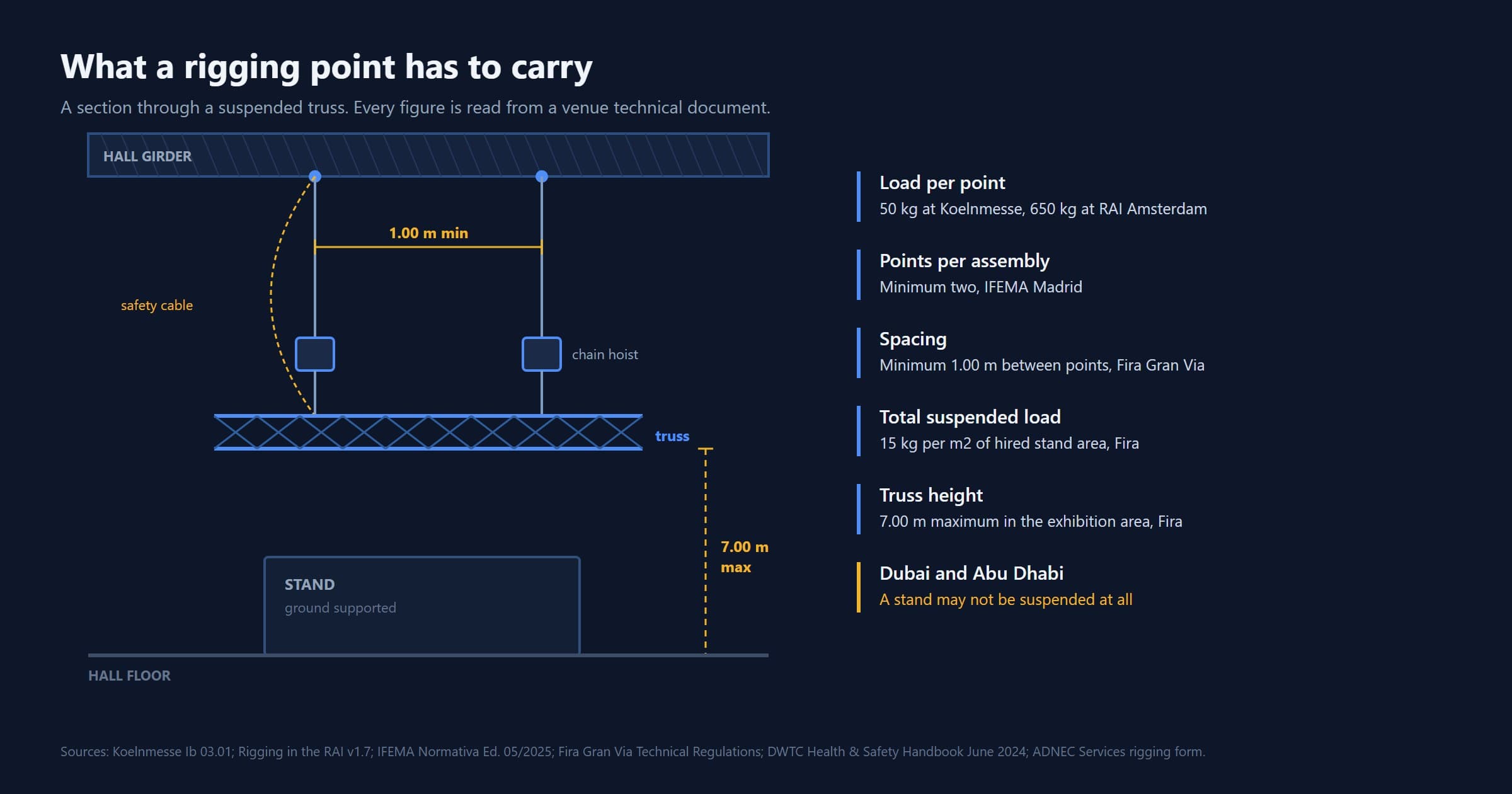
- Cologne and Düsseldorf: 50 kg per point. The two lowest limits we found.
- Amsterdam: up to 650 kg, but it changes hall by hall, down to 125 kg.
- Dubai and Abu Dhabi: you may not hang the stand from the roof at all.
- London: no kilogram limit published. A rate card instead.
- Las Vegas: manual chain hoists are banned outright.
How much weight can one rigging point carry?
Rigging is the practice of suspending elements from a hall roof rather than supporting them from the floor. A rigging point is the single anchor the venue installs for you, and its rating is the number that decides your design.
| Venue | Max per point | Which halls or conditions |
|---|---|---|
| Koelnmesse | 50 kg | All halls, one flat figure |
| Messe Düsseldorf | 50 kg | Every hall, per suspension point |
| Messe Frankfurt | 50 or 100 kg | By named hall, manual chain hoists |
| RAI Amsterdam | 125 to 650 kg | Varies by hall and by fixing |
| Fira Gran Via | 150 to 350 kg | By hall, high capacity on request |
| IFEMA Madrid | 250 to 500 kg | 500 kg at truss nodes, pavilions 1 to 10 |
| ExCeL London | Not published | A 1.5 safety factor instead |
| Las Vegas | Not published | Approval needed above 200 lbs |
| DWTC Dubai | Not applicable | Stand suspension forbidden |
| ADNEC Abu Dhabi | Not applicable | No stand structure may attach to the ceiling |
Two entries carry a caveat. Frankfurt's Technical Guidelines set 50 kg in sixteen named halls and 100 kg in ten others plus the Forum. However, those cap what a manual chain hoist may raise. They are a constraint on method, not a rating of the hall's points.
IFEMA's 500 kg is conditional on position. Its Normativa para colgar estructuras en pabellones, edition 05/2025, allows 500 kg "en los nudos de las cerchas" in pavilions 1 to 10. Between the nodes it halves to 250 kg.
The area limit nobody quotes
Fira Barcelona adds a second ceiling that catches large stands. Its Gran Via regulations cap the total at "15 kg per m2, calculated by the ratio of the total weight of the suspended elements to the hired stand surface". A 100 m2 stand therefore gets 1,500 kg in total, however many points you order. Consequently a designer who checks only the per-point figure can clear every point and still fail the stand.
RAI derates differently. Its regulations set "the maximum permissible load is 0.5 times the (industrial) WLL". Working load limit, or WLL, is the manufacturer's rated capacity for a sling or shackle. In Amsterdam you may use half of it.
Who is allowed to install a rigging point?
This is the answer that changes a quote. At every venue we checked, you do not install primary rigging. The venue or its named contractor does.
| Venue | Who installs | Named in the document |
|---|---|---|
| Messe Frankfurt | Messe Frankfurt and contracted firms | Yes |
| Koelnmesse | UEBERKOPF GmbH | Yes |
| Messe Düsseldorf | Messe Düsseldorf | Yes |
| Fira Gran Via | Fira official suppliers | Not named |
| IFEMA Madrid | IFEMA installs all safety cables | Partly |
| ExCeL London | ExCeL rigging team or appointed supplier | Not named |
| DWTC Dubai | DWTC Event Services | Yes |
| ADNEC Abu Dhabi | ADNEC Services, exclusive right | Yes |
| Las Vegas | The appointed general service contractor | Varies by show |
| RAI Amsterdam | One dedicated partner | Not named |
Koelnmesse is the most explicit. Its information sheet Ib 03.01 states that objects "only may be hung up by the service providers of Koelnmesse GmbH", and its service partner directory names UEBERKOPF GmbH for suspensions in all halls.
Primary rigging is the venue's attachment to the roof. Secondary rigging is what you attach to that point. ExCeL reserves the first and permits the second. Its guidelines say contractors "are permitted to make secondary fixings to rigging points supplied by the venue", provided the arrangement is applied for at least 28 days ahead. Consequently a contractor who assumes total exclusion there leaves work on the table.
Las Vegas is the exception. The LVCVA requires only that "Only qualified riggers may be used". Exclusivity sits with whichever general service contractor the organiser appoints. Therefore check the show rather than the venue.
Which venues do not allow stands to be rigged at all?
At Dubai World Trade Centre, an exhibition stand cannot be hung. Its Health and Safety Handbook is unambiguous:
"It is important to note that stands built for the purpose of exhibitions or events at the venues are not permitted to be suspended from the roof of the venues and must be ground supported."
The roof at DWTC is available to the organiser suspending trusses through the Rigging Form. It is not available to an exhibitor suspending a stand.
Abu Dhabi agrees. The ADNEC Services rigging form states that "no stand structure is allowed to be attached to ADNEC ceiling as either a precautionary or additional safety measure". It also requires that ground mounted structures "shall be so designated and constructed to be fully self-supporting".
Cologne reaches the same place differently. Its guidelines permit hanging, but not hanging that holds the stand up:
"Elements that require suspension devices for such stability are not permitted. Projecting parts of constructions that stand in a stable manner on the floor are permitted to be hung from the hall ceiling."
In other words, three of our ten venues restrict what rigging may do structurally. Therefore a design cleared in Barcelona is not a pricing problem in Dubai. It is a redesign.
What does exhibition stand rigging cost?
One venue in ten publishes a rate card. ExCeL London does, and these are its 2026 rigging rates in GBP for a one week hire.
| Item | Advance | Standard | Late |
|---|---|---|---|
| Lifting point | 179 | 215 | 258 |
| Electric chain hoist | 152 | 182 | 219 |
| Manual chain hoist | 139 | 167 | 200 |
| Hoist and fix service | 583 | 700 | 840 |
| De-rig service | 583 | 700 | 840 |
| Motor control, cabling and mains | 1,434 | 1,721 | 2,065 |
| Labour | 517 | 620 | 744 |
Advance means 28 days or more ahead. Late means within seven days.
Now read the small print. Four separate lines are compulsory once you order one electric chain hoist. ExCeL states that the "Hoist and Fix & De-rig charge is compulsory for manual and electric hoist hire", that "rigging mains distribution is compulsory for electric hoist hire", and that "'Lifting Points' and 'Electric Motor Control, Cabling & Mains' are a compulsory purchase when ordering Electric Chain Hoists".
Consequently a single electric hoist is never GBP 152. At advance rates it is 152 for the hoist, plus 179 for the lifting point, plus 583 to hang it, plus 583 to remove it, plus 1,434 for motor control and mains. The real figure is GBP 2,931 before VAT.
Is the GBP 800 to GBP 2,500 range page one quotes wrong? Not exactly. It is unattributable, which is worse. It names no venue, and at ExCeL it understates one electric hoist.
For the rest, the rate is not public. RAI, Koelnmesse, UEBERKOPF, IFEMA, LVCVA and every German venue here publish rules without prices. IFEMA's Normativa says twice that it will invoice "según las tarifas en vigor", according to the rates in force, without ever publishing them.
Two further figures need their date attached. ADNEC Services listed a roof point at AED 2,239 early bird. However, the most recent price list we could verify is a 2020 event order form, so treat it as indicative only. At Las Vegas, Freeman charges USD 126.25 per hour. That is a plan processing rate for drawing conversion, not rigging labour.
What is the rigging deadline, and what does missing it cost?
No competitor tabulates this, and it varies by a factor of four.
| Venue | Rigging deadline | Late surcharge |
|---|---|---|
| Koelnmesse | 8 weeks before the event | 20 percent |
| RAI Amsterdam | 4 weeks before | Not published |
| IFEMA Madrid | 1 month before build-up | Not published |
| ExCeL London | 28 days for third-party fixings | 20 percent |
| Freeman, Las Vegas | 21 days before rigging starts | Not published |
| LVCVA, Las Vegas | 14 days before first move-in | Not published |
| ADNEC Abu Dhabi | Paid 15 days before the event | Standard price applies |
Las Vegas is the trap. Two documents govern one hall, and they set different dates. The venue wants final plans 14 days before move-in. In contrast, the contractor wants them 21 days before rigging starts. Consequently a team working to the LVCVA date alone is already a week late for Freeman.
What this actually means for a quote
Check the method before the weight
Several venues restrict the hoist rather than the load. For instance, Las Vegas is blunt: "Only electric hoisted winches are allowed. Manual, nonelectrical hand chain fall and hand lever hoists are prohibited."
Others cap the count instead. Fira permits no truss grid raised on more than six manual hoists. Frankfurt allows no more than four in a single system. Meanwhile ADNEC requires electric hoists above four per lift.
Read the qualification requirement
Germany runs on DGUV 17 and 18, the statutory accident insurance rules for event sites. Frankfurt requires fitters certified under them. Düsseldorf requires an IGVW SQQ 2 qualified person for truss installation. Meanwhile RAI requires VCA or OHSAS 18001 certified companies.
The materials carry their own paperwork. Fira requires that equipment bear the CE marking and hold an up-to-date revision. Meanwhile IFEMA rejects any sling more than five years old from its date of manufacture.
Assume the point is not where you drew it
Fira states plainly that points are "not always possible to locate" everywhere. Pre-rigging may be required, and that adjustment "may entail additional costs that shall be charged to the exhibitor". Consequently the drawing is a request, not a plan.
In our experience, tracking those clauses across a season of shows is exactly the kind of thing that goes wrong in a spreadsheet. That is the problem our system exists to hold.
Questions builders ask
Can my own crew rig, or must I use the venue's team?
For primary rigging, you must use the venue or its named contractor at every venue we checked. Specifically, ExCeL, Koelnmesse and ADNEC all state it explicitly. However, ExCeL permits secondary fixings to venue-supplied points if you apply at least 28 days before the first day of tenancy.
What is the maximum weight per rigging point?
There is no industry figure. Specifically, IFEMA allows 500 kg at truss nodes in pavilions 1 to 10 and 250 kg between nodes. Meanwhile RAI ranges from 125 kg in Hall 9 to 650 kg in Hall 1. In contrast, Koelnmesse and Messe Düsseldorf both cap at 50 kg. Notably, ExCeL publishes no limit at all.
Why is my rigging quote higher than the per-point price?
Compulsory extras. Specifically, at ExCeL the hoist and fix charge and the de-rig charge are both compulsory with any hoist hire. In addition, a lifting point and mains distribution are compulsory with an electric hoist. Consequently that turns a GBP 152 electric hoist into GBP 2,931 before VAT at advance rates.
Can I use manual chain hoists?
Often not. For example, Las Vegas prohibits them outright. Koelnmesse allows them during setup only, after which they must hang without load. Similarly, IFEMA bans them on unitary structures with more than four hanging points. Meanwhile Fira allows a maximum of six per truss grid, and additionally derates the points to 150 kg.
Can I hang my stand from the ceiling?
No, at three of the ten. Specifically, Dubai World Trade Centre requires exhibition stands to be ground supported. Likewise ADNEC requires ground mounted structures to be fully self-supporting. Meanwhile Koelnmesse prohibits suspension that provides a standing structure's stability.
How we checked this
Our editorial rule is simple. Every number traces to a named, dated document, or it does not appear.
Every figure above was read from a venue document, not from a summary. Seven manuals were already extracted locally for our deadlines and two-storey articles, and we re-read each for its rigging clauses. In addition, five more documents were fetched for this piece. Across those twelve, we found the venues agree on far less than the industry assumes.
Importantly, three claims in wide circulation were rejected because we could not source them. First, a named exclusive rigging contractor at RAI, which no primary RAI page we could reach confirms. Second, a figure of 70 kg per running metre at ADNEC, which appears only in third-party show manuals. Third, an LVCC rigging labour rate of USD 165 to 225 per hour, which traces to nothing.
We would rather print a document's date than imply a freshness we cannot support. Spotted an error, or hold a current rate card we have missed? Tell us and we will correct it. More about how we work is on our about page.
Sources
| # | Document | Publisher | Edition | Supports |
|---|---|---|---|---|
| 1 | Technical Guidelines 2026 | Messe Frankfurt | September 2025 | Section 4.7.5: who may install, DGUV-17/18 certification, the 50 and 100 kg manual hoist hall lists, four hoists per system, the cable ties and carabiner bans |
| 2 | Technical Guidelines | Koelnmesse | July 2024 | That suspension may not provide a stand's stability, and that the guidelines carry no point load |
| 3 | Informationsblatt Ib 03.01, hanging objects from ceilings | Koelnmesse | Version 28.11.2017 | The 50 kg maximum point load, UEBERKOPF's sole responsibility, the 8 week deadline and 20 percent late surcharge. Retrieved from a third-party mirror; no copy is hosted on koelnmesse.com |
| 4 | Service partners | Koelnmesse | Current | Independent confirmation that UEBERKOPF GmbH holds suspensions in all halls |
| 5 | Technical Guidelines | Messe Düsseldorf | Valid from 1 January 2026 | Section 4.7.5: the 50 kg limit, brackets fitted only by the venue, Halls 7.0-7.2 and 15-17 on request, the IGVW SQQ 2 exemption |
| 6 | Normativa para colgar estructuras en pabellones, Rigging | IFEMA Madrid | Ed. 05/2025, in force 1 September 2025 | 500 kg at truss nodes and 250 kg between them, pavilions 12, 14.0 and 14.1, minimum two points, the manual hoist ban above four points, the five year sling rule |
| 7 | Normas Generales de Participación | IFEMA Madrid | Ed. 11/25 | Section 26, which defers rigging to the separate Normativa, and the hall 12 fire detection beams |
| 8 | Gran Via Technical Regulations | Fira de Barcelona | February 2025 | Section 3.7: exclusivity, the 150, 250 and 350 kg point classes, 15 kg per m2, 1 m spacing, six manual hoists, 7 m truss height, load cells |
| 9 | Health and Safety Rules and Regulations Handbook | Dubai World Trade Centre | June 2024 | Section 5.25: Event Services as sole provider, and that stands must be ground supported rather than roof suspended |
| 10 | Rigging Order Form, ADNEC Services official contracting form | ADNEC Services | World Urban Forum 10, February 2020 | Exclusive right to primary rigging, the ban on attaching stand structures to the ceiling, hook heights, and the AED price table. Prices are 2020 and are quoted as such |
| 11 | Rigging rate card 2026 | ExCeL London | 2026 | Every GBP figure in the cost table, and the four compulsory purchase notes |
| 12 | Rigging guidelines and checklist | ExCeL London | PDF created 29 October 2024 | Venue-only ceiling fixings, secondary fixings at 28 days, the 1.5 safety factor in place of a kilogram limit |
| 13 | Rigging in the RAI | RAI Amsterdam | Final, v1.7, 1 August 2021 | The 125 to 650 kg per-area limits, the 0.5 x WLL derate, VCA and OHSAS certification, the four week deadline |
| 14 | LVCC Regulations, excerpted from the Building Users Manual | Las Vegas Convention and Visitors Authority | MINExpo 2020 kit | The 14 day plan deadline, qualified riggers, the manual hoist prohibition, 25 lb per square foot catwalks |
| 15 | Las Vegas Convention Center Rigging Regulations | Freeman | FY23 | The 21 day contractor deadline, the 200 lb approval threshold, and the USD 126.25 per hour plan processing rate |
On currency. Two documents above are notably old. The Koelnmesse information sheet is from 2017 and the ADNEC price list is a 2020 event form. Both are labelled rather than presented as current. Therefore check the edition date before you plan against it, including this one.