


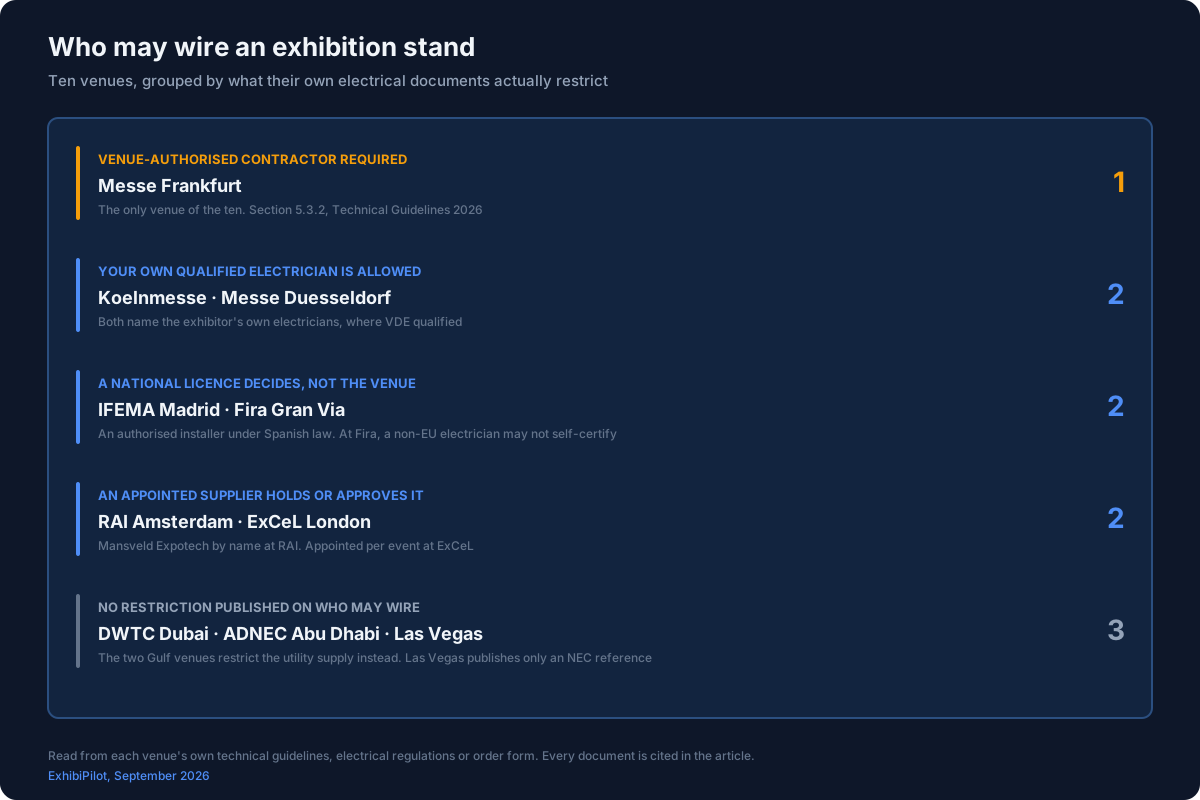
Exhibition stand electrical requirements split three ways, and only one venue of the ten we checked makes you use its own approved contractor. That venue is Messe Frankfurt.
Search this question and you get a flat answer. Dubai World Trade Centre and ADNEC forbid non-approved electrical contractors. We went looking for that clause. It is not there. What both Gulf venues publish is a monopoly on the utility supply, which is a different thing.
So we read the ten venues' own electrical documents and quoted them. Where a venue publishes nothing, we say so.
What the venues publish, at a glance
- Frankfurt: the only venue requiring its own authorised electrical contractor.
- Cologne and Düsseldorf: your own electricians are allowed, if VDE qualified.
- Amsterdam: one named firm holds the mains connection, Mansveld Expotech.
- Madrid and Barcelona: the licence is national, not venue-issued.
- Dubai: your contractor connects, and a DWTC electrician must attend.
- Abu Dhabi: a published price per amp, and no rule on who wires the stand.
The three questions page one merges into one
Every document we read separates three questions. The ranking pages treat them as one rule.
- Who may wire the stand. The board, the circuits, the fittings.
- Who connects it to hall power. The join to the building, and energising it.
- Who signs it off. The inspection that must pass before power goes on.
An approved contractor rule is a restriction on the first question. A service monopoly is a restriction on the second. Notably, almost every venue restricts the second while leaving the first more open than you would expect.
Exhibition stand electrical requirements, venue by venue
| Venue | Who may wire the stand | Who connects or energises | Sign-off before power |
|---|---|---|---|
| Messe Frankfurt | Contractor authorised by Messe Frankfurt | Messe Frankfurt contract partners | Not published |
| Koelnmesse | Own electricians, or VDE-authorised firms | Companies associated with Koelnmesse | Expert commissioned by Koelnmesse |
| Messe Düsseldorf | Own skilled personnel, or licensed VDE firms | Only the organiser | Independent expert, venue arranged |
| IFEMA Madrid | An authorised installer company | The stand's installer, supervised | IFEMA Technical Management |
| Fira Gran Via | Electrician authorised by the Generalitat | Fira activates, the installer connects | Fira Industry Service |
| RAI Amsterdam | Approved by RAI's recognised contractor | Mansveld Expotech, exclusively | Inspection to NEN 1010-6 |
| ExCeL London | The event's appointed contractor | Not published | Not published |
| Las Vegas | Not published in the extract | Not published in the extract | Not published |
| DWTC Dubai | The exhibitor's own contractor | The contractor, to the stand board | DWTC electrician |
| ADNEC Abu Dhabi | Not restricted in the form | ADNEC Services holds utility rights | Not published |
Each venue's figures also sit on its own page, linked from every row above and indexed at all ten venues.
Messe Frankfurt is unambiguous, and it is alone. Section 5.3.2 of its Technical Guidelines 2026 opens generously, allowing installation by "an approved hall electrician", then closes the door: "Installation shall be performed by an electrical contractor authorised by Messe Frankfurt." Frankfurt takes the outlet too, fitting it "exclusively by contract partners" and charging a fee for it. In practice that means two suppliers you do not choose, on one stand. It is also the only venue banning self-supply, prohibiting power from "energy storage or generation systems" brought to the stand, which covers batteries and photovoltaics. Consequently a battery wall is a compliance question in Frankfurt before it is a design one. Notably, Frankfurt publishes no pre-energisation inspection in section 5.3, unlike its three European neighbours. We record that as not published rather than as not required.
Koelnmesse and Messe Düsseldorf say the opposite, and both say it plainly. Koelnmesse permits installations "either by the exhibitors' own electricians or by specialist electrical companies which have been authorized in accordance with VDE". Düsseldorf permits "skilled electrical personnel provided by exhibitors or by licensed specialised companies". Therefore the gate in Cologne and Düsseldorf is qualification, not a supplier relationship. VDE is the German Association for Electrical, Electronic and Information Technologies, so your own staff qualify if they meet it.
Who connects the stand to hall power
This is the restriction that actually bites, and it is nearly universal.
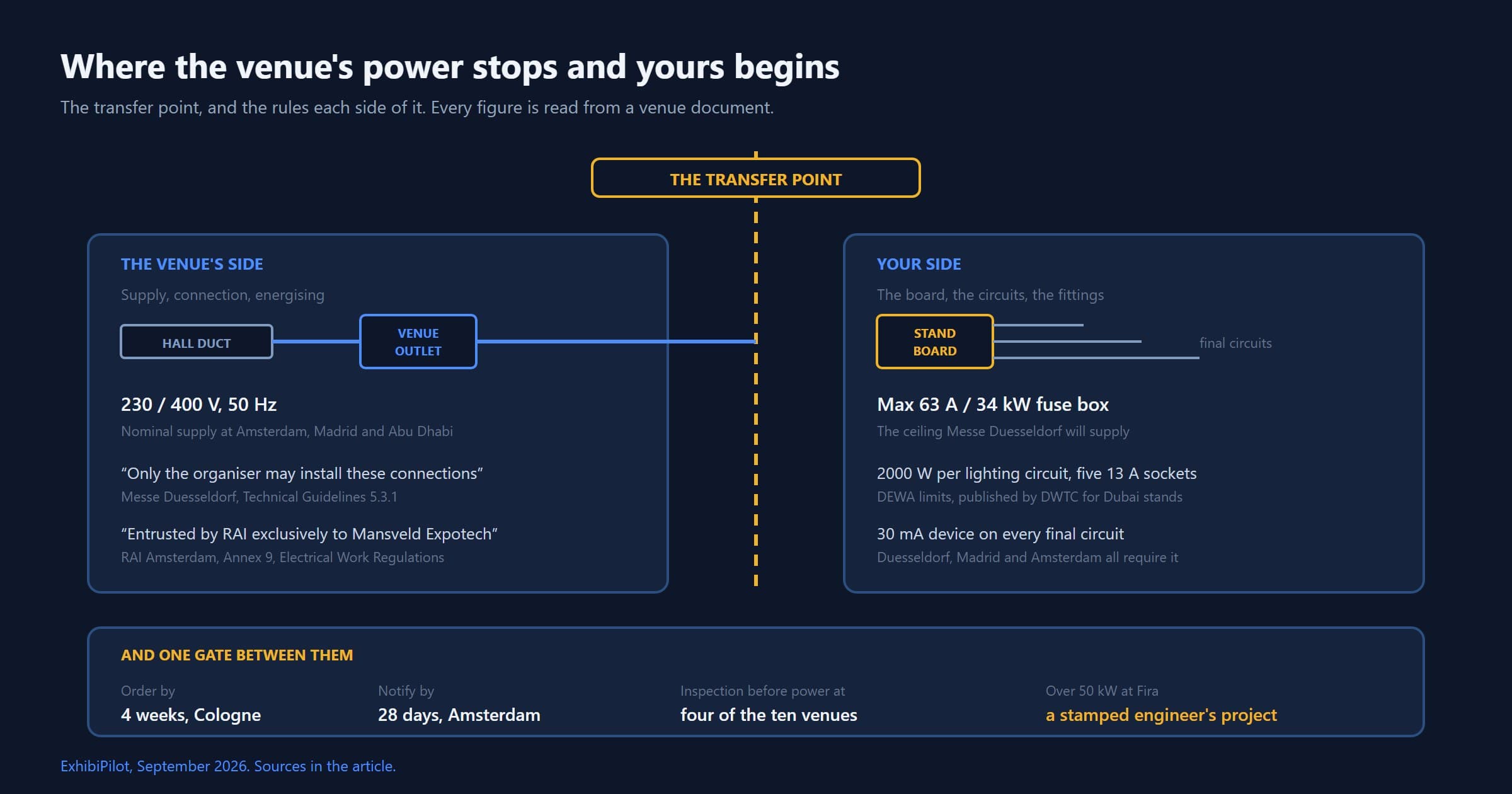
Frankfurt fits outlets only through its contract partners. Koelnmesse supplies connections "exclusively by the electrical companies associated with Koelnmesse". Düsseldorf is blunter: "Only the organiser may install these connections." Düsseldorf also draws the boundary precisely, since "the transfer point for all outlets is always the Messe Düsseldorf distribution box". The venue brings power to a box and stops.
RAI Amsterdam goes furthest by naming the company. Connecting stands to the mains "is entrusted by RAI exclusively to Mansveld Expotech". RAI also forbids the workaround, as standholders "are not permitted to lay on their own power supply, for example by means of generators".
However, three venues hand the physical connection back to you, and this is the detail most often wrong in a quote. IFEMA Madrid has the connection made "por el instalador del stand", under venue supervision. Fira activates the supply while "the physical connection to the outlet must be made by the electrical installer of the stand". DWTC assigns it to you outright, making the contractor responsible for "connection from DWTC main power supply cable to contractor stands DB".
Who signs it off before power goes on
Four venues publish a hard inspection gate. Builders forget this line, because it is neither cable nor labour.
Koelnmesse inspects before it connects, and says what failure costs: it is "obliged to refuse connection to the supply network", and "the exhibitor is liable for the costs of correct installation and further inspections". Düsseldorf requires a third party, since installations "may only be commissioned after being approved and released for use by an independent expert". RAI ties the gate to a standard, requiring inspection "in accordance with NEN 1010-6 before being put into operation". IFEMA makes it paperwork: an empresa instaladora autorizada is an installer company authorised under Spanish national law, and only its stamp counts on the inspection sheet. DWTC runs the gate in person, since "where an installation is found to be unsatisfactory, the electrical supply will not be connected".
The claim about Dubai and Abu Dhabi, checked
Now the correction, because this is why we wrote the piece.
DWTC's handbook treats your contractor as an ordinary participant. Its engineer "will advise the exhibitor or the exhibitor's electrical contractor of the required improvements". That sentence assumes your electrical contractor exists, and the handbook goes further by making that contractor responsible for the connection to the stand board. Crucially, DWTC claims exclusivity when it wants it, calling Event Services "the sole provider of all top and primary rigging" and compressed air an "exclusive service". The handbook plainly knows how to say sole provider. It does not say it about electrical contracting. Its published rules instead govern the work itself, capping lighting circuits at "2000 watts" and radial sub-circuits at "a maximum of five 13 Amps" sockets. Full context sits on our DWTC venue page.
ADNEC's position is similar, but the evidence is weaker and we will not overstate it. Its contracting form states that "ADNEC Services holds the exclusive right to utility services within ADNEC". Utility services means supply. The same form then hands you the operation, since "stand contractors are responsible for switching on their mains power 1 hour before" the show.
So here is what we can say. Neither venue publishes a prohibition on using your own electrical contractor. Both publish text assuming you have one. One caveat belongs on that finding, however. ADNEC publishes an order form, not a technical regulation, and absence of a restriction in an order form is weaker evidence than Cologne's explicit permission. If ADNEC restricts stand wiring, it does so in a document we could not obtain, and the burden of producing it sits with the pages making the claim. The safe move is therefore narrow. Ask the organiser in writing for the show's appointed electrical contractor, and ask separately whether your own electrician may work behind the board. Those are two different questions, and the second is the one that moves the price. Our DWTC approval guide covers the wider Dubai submission process.
What stand power costs at ADNEC
ADNEC publishes a full price ladder in AED, inclusive of 5% VAT. No ranking page we found cites it.
| Supply | Early bird | Standard |
|---|---|---|
| 16 A single-phase | 880.00 | 960.00 |
| 32 A single-phase | 1,759.00 | 2,079.00 |
| 16 A three-phase | 2,646.00 | 3,038.00 |
| 63 A three-phase | 7,514.00 | 8,153.00 |
| 100 A three-phase | 12,390.00 | 14,868.00 |
| Build-up power | 336.00 | 403.00 |
| Single phase distribution board | 2,398.00 | 2,878.00 |
| Three phase distribution board | 3,517.00 | 4,221.00 |
Round-the-clock supply adds 20%, which matters for refrigeration or servers. Read the payment terms as part of the price. Every order must be paid 15 days before the event, and the standard rate then replaces the early bird rate on anything unpaid 14 days out. Cancelling a confirmed order costs 30% of the invoice. Consequently the gap between those two columns is a deadline, not a discount, and it is one a finance approval can easily miss. One further detail catches large stands. Any supply above 16 A single-phase arrives as "a 16 Amps Single-Phase power connection for build-up period only". Your full supply is there for the show, not for the build. Therefore a stand running tools or lifts during build-up should order build-up power as its own line, at 336 early bird.
Two venues where the licence is national
Spain is the outlier worth understanding, because the gate is a government register rather than a venue list. IFEMA Madrid works to the Reglamento Electrotécnico de Baja Tensión, and its inspection sheet needs the stamp of an authorised installer company. Fira Gran Via applies the Catalan version and is more demanding, requiring an electrician "officially authorized by the Industry Department of the Generalitat of Catalonia".
Then comes the rule nobody writes about. Fira separates electricians by nationality:
"Non-EU electricians must make Fira de Barcelona directly responsible for the electrical distribution switchboard."
Read that slowly if you are a British builder. Since Brexit, a UK electrician is a non-EU electrician. Therefore at Gran Via the switchboard becomes Fira's responsibility, and Fira's line item. A UAE or US builder sits in the same position. Notably, nothing in the clause turns on competence. It turns on where the licence was issued.
Legalisation is the Spanish term for certifying an installation with the regional authority, and Fira sets a threshold that changes it entirely. A stand up to 50 kW needs a technical design report. Above 50 kW it "must be legalized by means of a technical project created by a licensed engineer", stamped by the Catalonia School of Engineers. Generators above 10 kVA must be legalised too, and the costs "shall always be charged to the exhibitor".
The deadlines
| Venue | Deadline | What it governs |
|---|---|---|
| Koelnmesse | Four weeks before the event | The connection order, with a location plan |
| RAI Amsterdam | 28 days before first build-up day | Notification to the electrical supplier |
| ADNEC Abu Dhabi | Paid 15 days before the event | Price protection, standard rate at 14 days |
| DWTC Dubai | 24 hours in advance | Supply outside normal hours |
Koelnmesse attaches a condition that is easy to miss. Timely completion is assured only if circuit diagrams, connection values and locations arrive four weeks out. Therefore a late floor plan is a late electrical order, whatever date the form went in. The same pattern runs through our approval deadlines guide, where the paperwork date and the ordering date are rarely the same.
The two venues that publish almost nothing
ExCeL London publishes one sentence: "If you need power for any appliance, you will need to contact the appointed electrical contractor for the event." The contractor is appointed per show, so there is no venue-level answer. This matches its habit elsewhere, since on rigging it published a safety factor instead of a load limit.
Las Vegas is thinner still. The only rule in the document we hold is that "all electrical wiring must be installed per National Electrical Code® (NEC) standards". We could guess, since large US venues customarily appoint an exclusive service contractor. However, our rule is firm. A rule appears only with a document behind it, and the document we hold is a show-modified extract. So the cell stays empty and labelled.
What this means for a quote
Price the sign-off, not just the cable. Inspection is compulsory at Cologne, Düsseldorf, Amsterdam and Madrid, and at Cologne a failure is billed to the exhibitor along with the re-inspection.
Check whether your electrician's paperwork travels. A VDE-qualified electrician is accepted in Cologne and Düsseldorf and is not sufficient in Frankfurt. A Catalan licence is required in Barcelona, where a non-EU electrician cannot self-certify at all.
Assume the connection is not yours to make. At six of the ten venues it belongs to the venue or its named supplier. Conversely at Madrid, Barcelona and Dubai your installer connects, so your electrician must be on site at the right hour.
Questions builders ask
Must I use a venue-approved electrical contractor?
At one of the ten venues, yes. Messe Frankfurt requires installation by "an electrical contractor authorised by Messe Frankfurt". Koelnmesse and Messe Düsseldorf both permit your own electricians, if VDE qualified. IFEMA Madrid and Fira Gran Via require a nationally authorised installer instead. RAI Amsterdam requires approval by its recognised contractor. ExCeL London defers to the contractor appointed for each event.
Can my own electrician wire my stand?
In Cologne and Düsseldorf, yes. Koelnmesse permits "the exhibitors' own electricians" where they are authorised to VDE standards, and Düsseldorf permits "skilled electrical personnel provided by exhibitors". In Madrid and Barcelona your electrician needs the national authorisation. In Frankfurt they need the venue's.
Do DWTC and ADNEC forbid non-approved electrical contractors?
Not in anything either venue publishes. DWTC's handbook refers to "the exhibitor's electrical contractor" and makes that contractor responsible for connecting its main supply cable to the stand board. ADNEC's form claims an exclusive right to utility services, which is the supply, then makes stand contractors switch their own mains. Neither document restricts who may carry out stand electrical work.
Who makes the final connection to hall power?
It varies, and not by region. Frankfurt, Koelnmesse, Düsseldorf and RAI reserve it for the venue or its named supplier, with RAI naming Mansveld Expotech exclusively. IFEMA Madrid has the stand's installer connect under supervision. Fira activates the supply while the stand's installer makes the physical connection. DWTC makes the contractor responsible, with its own electrician present.
Can I bring a generator or batteries?
Not at Frankfurt or RAI Amsterdam. Frankfurt bans supplying a stand from "energy storage or generation systems" brought in, which covers batteries and photovoltaics. RAI states that standholders "are not permitted to lay on their own power supply, for example by means of generators". At Fira a generator is allowed, but must be legalised above 10 kVA.
How we checked this
Our editorial rule is simple. Every rule traces to a named, dated document, or it does not appear.
We read every clause above from a venue document, not from a summary. Seven manuals were already extracted locally for our two-storey and deadlines articles, and we re-read each for its electrical sections. Three more were fetched for this piece, covering London, Amsterdam and Abu Dhabi.
Importantly, we rejected the claim this topic rests on. Neither DWTC nor ADNEC publishes a ban on non-approved electrical contractors, and both publish text pointing the other way. Two cells are deliberately empty as a result, because ExCeL publishes no venue-wide rule and Las Vegas offers only an NEC reference. We would rather print the gap than infer a rule that merely sounds right.
Spotted an error, or hold a current electrical rate card we have missed? Tell us and we will correct it. More about how we work is on our about page.
Sources
| # | Document | Publisher | Edition | Supports |
|---|---|---|---|---|
| 1 | Technical Guidelines 2026 | Messe Frankfurt | September 2025 | Section 5.3: the authorised contractor rule, outlets by contract partners, and the self-supply ban. |
| 2 | Technical Guidelines | Koelnmesse | July 2024 | Section 5.3: own electricians permitted, the four week deadline, and inspection before connection. |
| 3 | Technical Guidelines | Messe Düsseldorf | Valid from 1 January 2026 | Section 5.3: only the organiser connects, the distribution box boundary, and independent expert release. |
| 4 | Normas Generales de Participación | IFEMA Madrid | Ed. 11/25 | The stamped inspection sheet, and connection by the stand's installer under supervision. |
| 5 | Gran Via Technical Regulations | Fira de Barcelona | February 2025 | Section 6.2: the Generalitat licence, the non-EU switchboard rule, and the 50 kW threshold. |
| 6 | Annex 9, Electrical Work Regulations | RAI Amsterdam | MK/221015 | Mansveld Expotech named exclusively, the generator ban, NEN 1010-6, and the 28 day notice. |
| 7 | Utilities Services for Exhibitors | ExCeL London | Current | The single published rule, pointing at the contractor appointed for each event. |
| 8 | LVCC Building Users Manual | Las Vegas Convention and Visitors Authority | Extract, November 2023 | Wiring to NEC standards, and the absence of any rule on who may carry out the work. |
| 9 | Health and Safety Rules and Regulations Handbook | Dubai World Trade Centre | June 2024 | Section 5.9: the exhibitor's electrical contractor, the stand board connection, and the DEWA circuit limits. |
| 10 | Space Only Electrical Order Form | ADNEC Services | Event contracting form | The exclusive right to utility services, contractors switching their own mains, and the AED price ladder. |
On currency. Venue guidelines get revised, and shows issue their own versions. The ADNEC document is an event contracting form rather than a dated regulation, so treat its prices as indicative. Therefore check the edition date before planning against it, including this one.