


There is no such thing as the floor load at IFEMA Madrid. IFEMA publishes 750 kg/m² and 15,000 kg/m² in the same table, in the same document. Which one applies to you depends on which pavilion you were allocated.
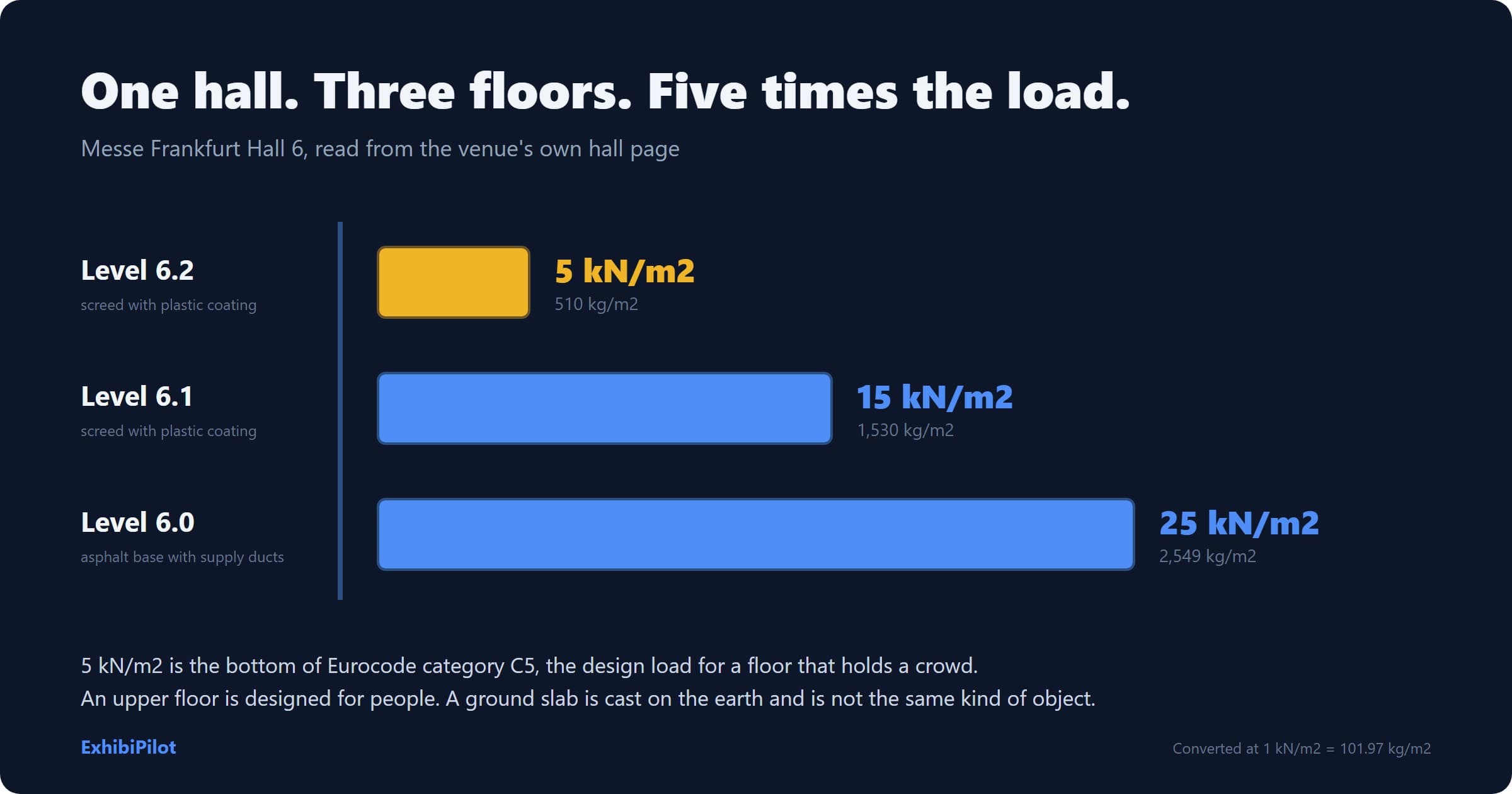
That pattern holds across the set. The spread inside one venue is consistently larger than the spread between venues. Messe Düsseldorf publishes 5 kN/m² and 100 kN/m². Koelnmesse runs from 7.5 to 50 kN/m² hall by hall. Messe Frankfurt's Hall 6 alone carries three different figures, one per level.
Therefore the question "how much weight can an exhibition hall floor take" has no venue-level answer. It resolves at hall, and then at level. As with the deadlines article, every figure below is read from a document you can open yourself.
What the venues publish, at a glance
- Madrid: 15,000 kg/m² in most pavilions, and 750 kg/m² in one.
- Düsseldorf: 10 tonnes per square metre on the ground, 500 kg/m² on named upper floors.
- Frankfurt: Hall 6 is rated 25, 15 and 5 kN/m² on levels 6.0, 6.1 and 6.2.
- Abu Dhabi: 1,000 kg/m², the lowest in the set, and not published by the venue at all.
- Las Vegas: unlimited, outside two named areas.
The full comparison
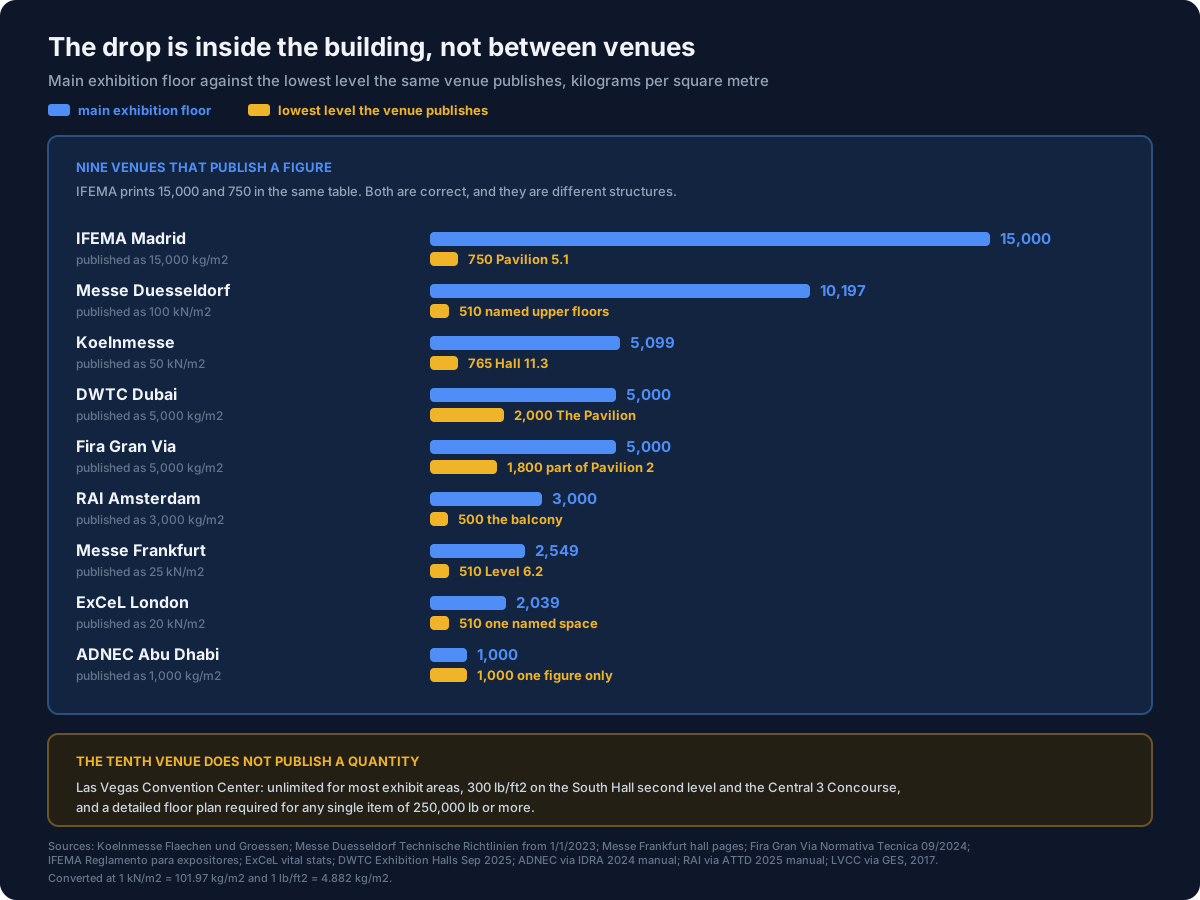
Two numbers matter, not one. The first is what the main exhibition floor carries. The second is the lowest figure the same venue publishes somewhere else in the building, which is where a stand gets caught out.
| Venue | Main floor, as published | Comparable kg/m² | Lowest published level |
|---|---|---|---|
| IFEMA Madrid | 15,000 kg/m², most pavilions | 15,000 | 750 kg/m², Pavilion 5.1 |
| Messe Düsseldorf | 100 kN/m², Hall 1 foyer | 10,197 | 5 kN/m², named upper floors |
| Koelnmesse | 50 kN/m², Halls 6 to 9 | 5,099 | 7.5 kN/m², Hall 11.3 |
| DWTC Dubai | 5,000 kg/m², Halls 1 to 8 | 5,000 | 2,000 kg/m², The Pavilion |
| Fira Gran Via | 5,000 kg/m², Pavilions 3 and 4 | 5,000 | 1,800 kg/m², part of Pavilion 2 |
| RAI Amsterdam | 3,000 kg/m², Hall 1 | 3,000 | 500 kg/m², balcony |
| Messe Frankfurt | 25 kN/m², Halls 3, 6.0 and 8 | 2,549 | 5 kN/m², Level 6.2 |
| ExCeL London | 20 kN/m², ICC Maritime Halls | 2,039 | 5.0 kN/m², one named space |
| Las Vegas | Unlimited, most exhibit areas | Not applicable | 300 lb/ft², South Hall level 2 |
| ADNEC Abu Dhabi | Not published by the venue | 1,000 | 1,000 kg/m², per show manuals |
Conversions in the third column are ours, at 1 kN/m² = 101.97 kg/m² and 1 lb/ft² = 4.882 kg/m². The second column is what the venue actually prints. Two rows carry a caveat. Las Vegas is the only venue in the set whose answer is a word rather than a number, and its document is the weakest sourcing here. ADNEC publishes nothing at all, which is covered further down. Notably, the ranking order changes completely depending on which column you read: Düsseldorf looks like the strongest floor in Europe on the ground and sits near the bottom of the set upstairs, because the two figures describe two different structures that happen to share a postcode.
Why the upper floor is almost always 500 kg per square metre
Look down the last column. Düsseldorf caps its upper floors at 5 kN/m². Frankfurt's Level 6.2 is 5 kN/m². RAI's balcony is 500 kg/m², which is the same number in different units. One ExCeL space is 5.0 kN/m². Four venues, three countries, one figure.
When we ran the conversions across the set, that repetition was the thing that stood out, and it is the part no ranking page explains. In fact it is not a coincidence at all, and the reason sits in a document none of the venues mention by name.
What Eurocode actually says
Eurocode 1 is the European standard governing the loads a structure must be designed to carry. Its first part, EN 1991-1-1, sorts floors into use categories and assigns each one a recommended imposed load. Table 6.1 places exhibition space in category C3, "areas without obstacles for moving people, e.g. areas in museums, exhibition rooms". It then defines category C5 as "areas susceptible to large crowds, e.g. in buildings for public events like concert halls, sports halls including stands, terraces and access areas". Table 6.2 gives category C5 a recommended range of 5,0 to 7,5 kN/m². So 5 kN/m² is not a venue being cautious. It is the bottom of the Eurocode band for a floor that holds a crowd, adopted as published.
A suspended upper floor in an exhibition hall is designed for people, because people standing shoulder to shoulder are the governing load case for a slab held up by beams. A ground floor is a different structure entirely. It is a slab cast on the ground, so its limit comes from the slab and the soil beneath it rather than from an assumption about crowds. Consequently the same building publishes 10,197 kg/m² downstairs and 500 kg/m² upstairs, and both numbers are correct. The two floors are not the same kind of object, and no amount of reading the venue's headline figure will tell you which one you have been sold. National annexes vary, so do not treat 5,0 as a single harmonised European number. The UK and France both adopt 5,0 kN/m² for category C5. Belgium adopts 4,5.
Distributed load is not point load
Distributed load is weight spread evenly over a square metre, and it is what every figure in the table above describes. It is not the weight you may stand on one spot.
Messe Düsseldorf states the distinction three times in a single section, in the same four words each time: "flächig aufgelagerte Lasten, keine Punktlasten". Loads bearing over an area, not point loads.
Point load is the opposite, and it matters more than the headline number, because a stand rarely loads a floor evenly. A machine sits on four feet. A display plinth sits on a frame. Eurocode handles this with a second value, Qk, the concentrated load, and for category C5 it is 3,5 to 4,5 kN. That is roughly 350 to 450 kg pressing on one small contact patch. Put plainly, a floor rated 500 kg/m² distributed will not take a 400 kg machine on four small feet without something underneath it to spread the load. Significantly, the two numbers answer different questions, and reading the first as though it answered the second is the most expensive mistake available here. Düsseldorf also publishes the fix, requiring a sub-construction matched to the floor's capacity above 100 kN/m². Las Vegas states the same requirement in plainer language: all cleated equipment must move on one inch plywood or steel plate, as determined by the engineering office.
What the ranking pages get wrong
Search for Fira Barcelona floor loading and you will find this, stated flatly and without a source: standard hall floor load is 3,000 kg/m² in Halls 1 to 6 and 2,000 kg/m² in Halls 7 to 8.
Carga Uso is the row heading Fira uses for imposed load in its own Normativa Técnica for Gran Via. We found it reads 3.000 for Pavilion 1, 5.000/1.800 for Pavilion 2, 5.000 for Pavilion 3, 5.000 for Pavilion 4, and 3.000 for Pavilion 5. Pavilions 3 and 4 are therefore rated 5,000 kg/m², not 3,000. The claim is wrong by two thirds for two of the five pavilions we could read, and a builder who priced a heavy exhibit out of Gran Via on that basis turned down work the venue would have allowed. We recovered no figure for pavilions 6, 7 or 8 on this pass, so we make no claim about the second half of that sentence. Where we cannot read it, we do not state it.
The same error class runs through the search results in a second way, through units. Page one for this query currently carries 0.52 kN/m², 500 kg/m², 1,200 kg/m², 2,000 kg/m² and 3,000 kg/m² with nothing reconciling them. The first of those is about 53 kg/m², and specifically it is not a hall capacity at all. It is a minimum design requirement for a raised stand floor, quoted out of a show's stand building rules. Listing it beside a hall rating as though the two were comparable is meaningless, and it is the reason the third column of our table exists.
Which venues publish nothing
ADNEC Abu Dhabi publishes ceiling height, floor area and capacity on its own website. It does not publish floor loading there.
The figure does exist. It appears in the exhibitor manuals of shows held at the venue, in one recurring sentence: "The ADNEC Hall Floors including duct/trench covers can withstand a loading of 1,000 kg/m2." The IDRA 2024 World Congress manual repeats it as a specification line, "Floor Load. 1,000kg /Sqm". Three independent manuals, one figure. That is good enough to publish, and we have, but note what it means in practice. To learn ADNEC's floor loading you must read somebody else's show manual, because the venue does not tell you directly. At 1,000 kg/m², ADNEC is the lowest ground floor rating in this set. DWTC, 120 km up the road, publishes 5,000 kg/m² for Halls 1 to 8 on its own September 2025 sheet. Two Gulf venues, a five fold difference, and only one of them says so publicly. If you build at both, as many Gulf stand builders do, that gap belongs in the design stage rather than at load-in.
There is a related trap at DWTC itself. A 2021 exhibitor manual for a show held there states "a maximum distributed weight loading of 2,000 kgs per m2 in each hall". That is The Pavilion's figure, applied in the manual to every hall, against 5,000 kg/m² on DWTC's own current sheet. The manual and the venue sheet carry different dates, so this is not necessarily an error that was wrong when written. Nevertheless it is a live illustration that the organiser's manual and the venue's own document are two different sources, which is the point the software layer map makes at length.
How to read this for your own stand
Ask for the hall, not the venue
"We are at Koelnmesse" tells you nothing useful. Hall 11.3 is rated 7.5 kN/m² and Hall 7 is rated 50 kN/m², and those are the same venue in the same week. Get the hall number into the brief before anyone sizes an exhibit.
Check the level before the weight
If the stand number has a decimal in it at a German venue, treat that as a warning. Frankfurt's 6.2, Düsseldorf's 7.1 and 7.2 and Koelnmesse's 11.3 are all upper floors, and each is a fraction of the ground floor below it. Similarly, anything described as a gallery, balcony, mezzanine or concourse should be assumed to sit in the 500 kg/m² band until the venue confirms otherwise. This is the single check that separates a stand that loads in from one that gets stopped, and it costs one email. Meanwhile the figure that appears on most venue summary pages is the ground floor number, because it is the flattering one, so the burden of asking sits with you rather than with the venue.
Work out the contact area, not just the mass
Divide the exhibit's weight by the area its feet actually touch, not by the area of the stand. That number is what the venue's engineer will ask for, and it is the one that triggers a spreader plate. Our two-storey guide covers the related case, where the stand itself is the load.
Notify above the threshold
Las Vegas requires a list of all heavy equipment before installation starts, and a detailed floor plan for anything at 250,000 lb or more. Fira, IFEMA and the German venues all route heavy exhibits through prior approval. That deadline sits alongside your other submission dates, and in our experience it is the one most often missed, because weight feels like a logistics problem rather than an approvals problem.
FAQ: questions people actually ask
How much weight can an exhibition hall floor hold?
It depends on the hall and the level, not the venue. Published ground floor figures across ten major venues run from 1,000 kg/m² at ADNEC Abu Dhabi to 15,000 kg/m² in most IFEMA Madrid pavilions. Upper floors, galleries and balconies are far lower, commonly 500 kg/m², and Las Vegas Convention Center publishes no limit at all for most of its exhibit areas.
What is the difference between distributed load and point load?
Distributed load is weight spread evenly across a square metre, and it is what venue floor ratings describe. Point load is weight concentrated on a small contact area, such as a machine foot. Eurocode gives them separate values: for a crowd-rated floor, 5,0 to 7,5 kN/m² distributed against 3,5 to 4,5 kN concentrated. A floor rated 500 kg/m² will not accept a 400 kg load on four small feet without a spreader plate.
Do I need venue approval for a heavy exhibit?
Usually yes, above a stated threshold. Messe Düsseldorf requires a load-spreading sub-construction for anything over 100 kN/m². Las Vegas Convention Center requires a list of all heavy equipment before installation begins, and a detailed floor plan for any item of 250,000 lb or more. Treat it as an approval with a deadline, not a logistics detail.
How this was researched
Who it is for. Stand builders, exhibition companies and project managers sizing exhibits against a hall they have not worked in before.
Who wrote it. Founder, ExhibiPilot. The method below matters more than the byline, and there is more about ExhibiPilot if the byline matters to you.
Method. We analyzed each venue's own hall data or technical regulations and recorded the figure exactly as published, with its unit. Conversions to kg/m² are ours and are marked as such throughout. Where a venue publishes nothing, the table says so rather than guessing.
Editorial note. Every figure here is fact-checked against the edition named beside it in the Sources table. One claim did not survive that check. ExCeL's vital stats document states 18 kN/m² in one place and 20 kN/m² in another, which looked like the venue contradicting itself and would have made a better headline than anything else we found. It is not a contradiction. The 18 figure sits under the heading for the North and South event halls, and the 20 under the ICC Maritime Halls. Different halls, both correct, so we cut the claim rather than soften it.
On the Las Vegas row. Our source is an exhibit hall specification hosted by GES, a contractor, whose own file metadata dates it to 2017. It is the weakest sourcing in the table and we flag it rather than quietly levelling it with the rest. Treat "unlimited" as directionally right and confirm with LVCVA engineering before relying on it.
On the RAI row. RAI's hall fact sheets sit behind its organiser portal and were not publicly readable on 3 October 2026. The 3,000 and 500 kg/m² figures come from a show manual for an event held in Hall 1, so they are attributed to that manual rather than to RAI directly.
Corrections. Hold a newer document that changes a figure here? Tell us and we will date and update the page. Terms above sit in our glossary.
Sources
| # | Document | Publisher | Edition | Supports |
|---|---|---|---|---|
| 1 | Flächen und Größen | Koelnmesse | Current, read 3 October 2026 | Per-hall kN/m², 7.5 to 50 |
| 2 | Technische Richtlinien | Messe Düsseldorf | Valid from 1 January 2023 | 100 kN/m², the named 5 kN/m² floors, the sub-construction rule, the point load wording |
| 3 | Hall 6 | Messe Frankfurt | Current, read 3 October 2026 | Levels 6.0, 6.1 and 6.2 at 25, 15 and 5 kN/m² |
| 4 | Normativa Técnica Gran Via | Fira de Barcelona | September 2024 | Carga Uso per pavilion, and the correction |
| 5 | Reglamento para expositores | IFEMA Madrid | Current | Carga Uso 750 to 15,000 kg/m² |
| 6 | Vital stats, metric | ExCeL London | Current | 18 kN/m² event halls, 20 kN/m² ICC Maritime |
| 7 | Exhibit Hall Specifications | GES, for LVCVA | Dated 2017 in file metadata | Unlimited, 300 lb/ft², the 250,000 lb threshold |
| 8 | Exhibition Halls 1-8 | Dubai World Trade Centre | September 2025 | 5,000 kg/m² Halls 1 to 8, 2,000 kg/m² The Pavilion |
| 9 | IDRA 2024 Exhibitor Manual | International Desalination Association | September 2024 | ADNEC 1,000 kg/m² |
| 10 | Tech Fair Exhibitor Manual | Kenes Group, ATTD 2025 | 2025 | RAI Hall 1 at 3,000 kg/m², balcony 500 kg/m² |
| 11 | EN 1991-1-1 imposed loads | European Commission, Joint Research Centre | Eurocodes, 2022 | Category C3 and C5 definitions, qk 5,0 to 7,5, Qk 3,5 to 4,5 |
On currency. Venue data gets revised, and individual shows issue manuals with their own figures. Where the two differ, read both and ask the venue which governs. Check the edition date before planning against any of them, including this page.